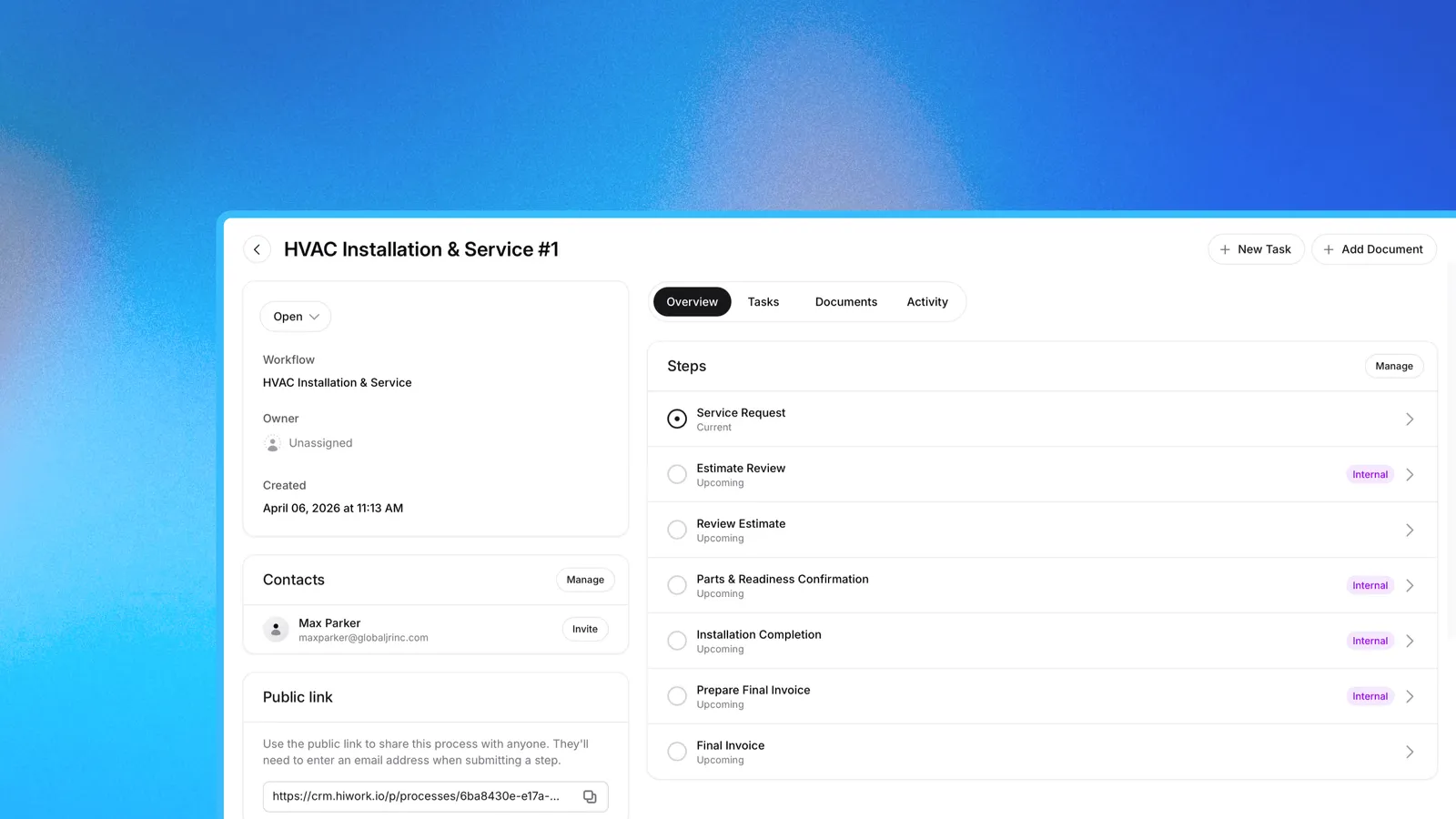
Managing any work in general takes more time than it should. Chasing someone for an approval. Figuring out who is supposed to act next. Searching through email to piece together what happened on a case three weeks ago.
Most of that time is not spent on the actual work. It is spent on the coordination around it. Structured workflows cut that down significantly. Here is where the difference shows up most.
Five ways workflows make your team more productive
- You design a workflow once and reuse it every time
- Ownership is always clear
- Approvals happen inside the workflow, not in email
- The full history of every workflow is always visible
- Tasks, documents, and contacts connect to the workflow they belong to
Here is what each one looks like in practice.
1. You design a workflow once and reuse it every time
A workflow is a structured, step-by-step sequence that defines how a piece of work moves from start to finish. Each step has a clear action, an owner, and a defined outcome before anything moves forward.
Every repeatable process your team runs starts the same way. Same steps, same checkpoints, same information to collect. The problem is that without a system, each new instance gets rebuilt from scratch. Someone starts an email chain. Someone else creates a folder. The process exists, but it lives in different places every time.
Workflow templates let you design a workflow once and run it for every new client or case from that point forward. The steps are defined. The transitions are configured. The custom fields that collect the right information at each stage are already in place. When a new workflow starts, the structure is already there.
This matters most when the team grows. A new team member does not need to learn the workflow from a colleague or a document. The workflow is the documentation.
2. Ownership is always clear
The most common reason something stalls is that nobody is sure whose turn it is. A step was completed, something was submitted, and now the file sits waiting while two people each assume the other is handling it.
When each step in a workflow is assigned to a specific person, there is no ambiguity. When a step becomes active, the assigned person knows it is on them. Nobody has to check in to find out what is pending. Nobody has to send a message asking who is responsible. The workflow carries that information.
Ownership at the overall level matters too. Every active process should have a named owner who is accountable for it moving forward, separate from whoever is assigned to individual steps.
3. Approvals happen inside the workflow, not in email
A workflow with an approval step means nothing moves forward until the right person signs off. The problem is that most teams run those approvals through email, which is where they get buried.
The fix is to keep approvals inside the workflow itself. When a step is submitted, the assigned reviewer approves or rejects it directly in the platform. If approved, the workflow moves to the next step automatically. If rejected, the step goes back for revision, with the rejection reason attached so the person who submitted it knows exactly what to address.
The approval becomes a documented action inside the workflow, not a thread in someone’s inbox that gets lost within a week.
4. The full history of every workflow is always visible
A workflow is only as useful as the visibility it provides. When a client asks where their case stands, the answer should take seconds. When a handoff happens mid-workflow, the person taking over should be able to open the record and understand exactly what has happened without a briefing.
That requires a complete audit trail. Every submission, approval, rejection, and status change logged with a timestamp and the name of the person who took the action. The history does not need to be assembled from email threads or reconstructed from memory. It should already be there.
This matters for compliance and accountability too. If a question comes up about a decision made weeks ago, the record shows exactly what happened and when.
5. Tasks, documents, and contacts connect to the workflow they belong to
Information that is not connected to anything useful becomes noise. A document saved in a folder that nobody labels consistently. A task created for a client but disconnected from the project it belongs to. A note that makes sense today and means nothing in three weeks.
The right setup is to have tasks, documents, and contacts attach directly to the workflow they are part of. When you open a process, everything related to it is in one place. The files collected at intake, the tasks assigned during execution, the contacts involved. Nothing has to be cross-referenced or hunted down.
It also works in the other direction. When you open a contact record, you should be able to see the workflows that contact is part of. The contact database and the workflow layer connected, not two separate systems you have to jump between.
If you are looking for a tool that works this way, Lattney combines a CRM with structured, approval-based workflows, all in one platform. Easy to start, no credit card required.