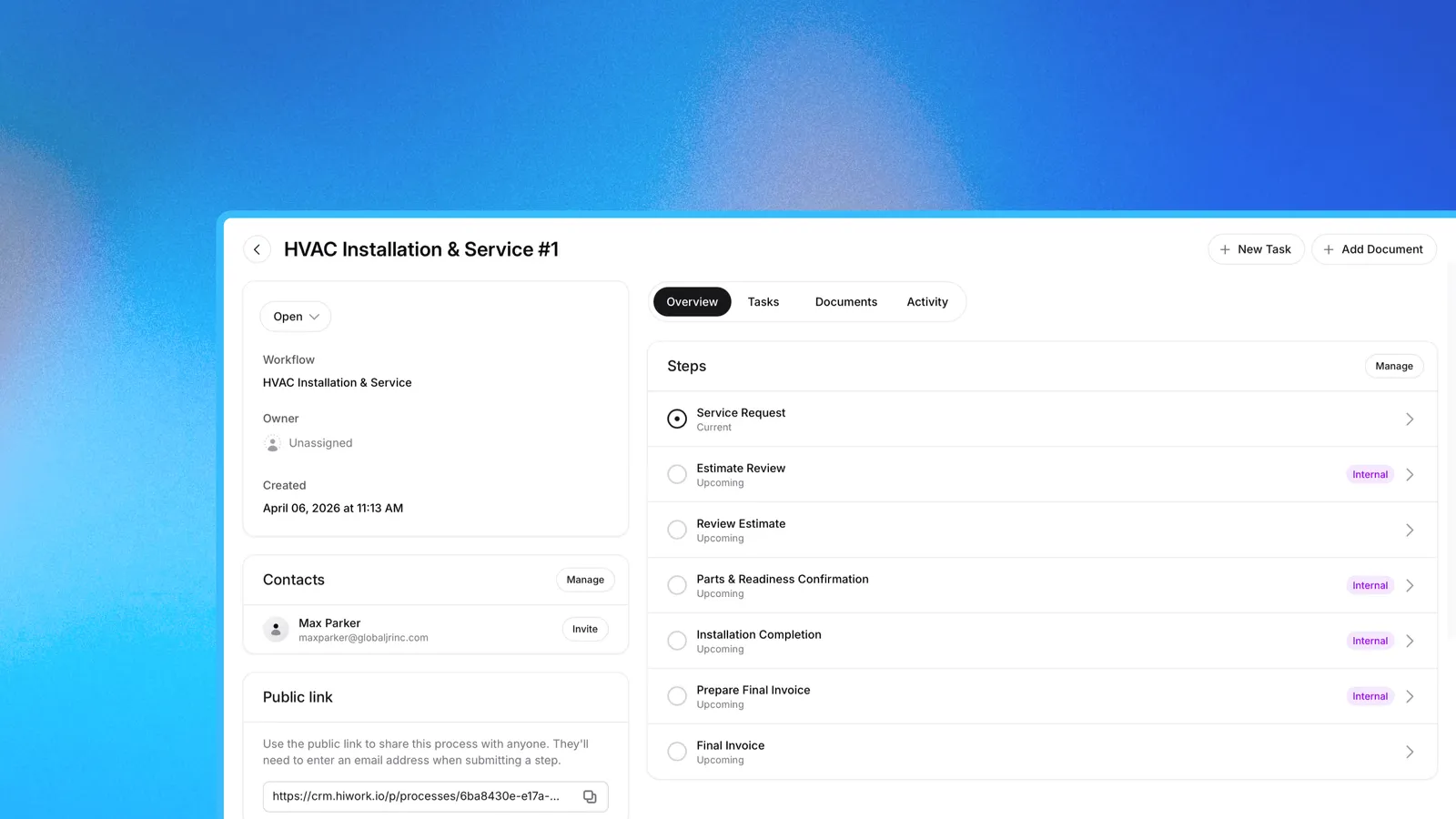
Some CRMs are a filing cabinet. They are a good place to look up a number, read the last note, check when you spoke to somebody. An operational CRM is the other kind. It is where the job itself gets done, so the steps and the sign-offs sit next to the client they belong to.
There is a quick way to tell the two kinds apart. Ask where the work actually happens. If your team runs the job through email and then goes back into the CRM to type up what happened, the CRM is a filing cabinet, and somebody is spending an hour a week on that typing.
A demo will not tell you whether a product is a filing cabinet or an operational CRM. Every demo looks good. A clean pipeline, a tidy contact record, a chart that moves. What a demo never shows you is the Tuesday three weeks in, when a client has gone quiet and two people each assume the other one is chasing it.
So you have to test the product yourself. Here is how.
What an operational CRM is
An operational CRM keeps your contacts and the work you do for them together in one place: the tasks, the notes, the documents, the follow-ups, the workflow steps, the approvals, and the record of what happened and when.
The point is that the work lives in the CRM. Nobody is doing the job in their inbox and then writing it up somewhere else afterwards.
Say you run a small consultancy company. The client requests are piling up. One client calls about a change to a job. Another emails about a different one. Nothing is written down, so every request sits wherever it landed.
An operational CRM gives you one way in. You set up a process, and every client goes through it. Requests come in the same way every time, and each one attaches to the client it came from.
Six months later that client is back, and wants the same job done again. You do not have to remember it. It is all on their record: what they asked for, what you sent them, who signed it off. The client knows how it works too, because nothing has changed since last time.
How to know if you need an operational CRM
The best way to find out is to look at your own process first. Take the job you do most often, and write down four things about it.
- What the steps are. Put them in order, including the one everybody forgets. That list is your test case, and it goes into every demo with you.
- Who owns each step. If there is a step you cannot name an owner for, you have found a problem, and buying software will not solve it for you.
- Where the client comes in. Some steps need the client to send something, or to approve something. That is a different job from an internal checklist.
- What someone might ask you about in six months. Approvals, documents, dates. Anything you would hate to have to piece back together from memory.
If that list is short, and one person does all of it, a contact list is probably enough. If it runs to several steps, passes between people, and involves the client, you need an operational CRM.
Either way, those four answers are now your shopping list. The rest of this post is how to judge a product against it.
Six things to test in a free trial
- Can it hold your real process?
- Does every step have an owner?
- Is an approval a gate, or just a reminder?
- Can a client take part without signing up?
- Can you see what changed last week?
- Can you set it up on your own?
1. Can it hold your real process?
Build the list of steps you wrote down, inside the trial. Build the real list, not a tidied version, with the awkward step and the branch that only happens sometimes.
Most tools handle a straight line of stages well. They come apart at the point where a step sends the job backwards, which is what happens every time a reviewer rejects something. If your process has a review in it, build that part first, because a review is where tools break.
2. Does every step have an owner?
A status tells you where a job is. A status does not tell you who is holding the job right now.
Look for an owner on the step, not on the client. Some CRMs give each account an account manager, which is not the same thing. That tells you who owns the client. It does not tell you who owns the next step, and the next step is where jobs stall.
3. Is an approval a gate, or just a reminder?
Some steps cannot start until somebody has said yes. A quote gets signed off. A document gets checked. A finished job gets marked complete by someone other than the person who did it.
Almost any tool will let you add an approval as a task that anyone can tick, and a task anyone can tick is a reminder. So ask the salesperson one plain question: can the next step start while the approval is still open? If it can, the tool is relying on people to remember, and relying on people to remember is what you are trying to stop doing.
4. Can a client take part without signing up?
Client-facing steps are where a process leaks. You send the client a form, or an email asking for documents, and what the client sends back lands in one person’s inbox.
Ask to see what the client sees, and look at it on a phone. What you want is a link the client can use without making an account, and files that arrive attached to the step they belong to. What you do not want is one more email attachment that somebody has to save somewhere sensible.
5. Can you see what changed last week?
A spreadsheet cell holds one value, today’s. Change the cell and yesterday’s value is gone. Plenty of CRMs overwrite the old value in the same way.
So in the trial, change something. Then try to find out what it used to say, who changed it, and when. If finding that out takes you more than a few seconds, the answer will not be there in six months when a client asks why their job took three weeks.
6. Can you set it up on your own?
People skip this test, and it is the one that decides whether the tool gets used.
Big CRMs are configurable enough that setting one up becomes a project, with a budget and a consultant attached to it. A small team needs a tool it can set up itself, and change again next month without asking anyone for help. Look at whether there are ready-made templates to start from, then try changing one and see how far you get.
The same week, twice
A small consultancy company signs a new client on Monday.
Without an operational CRM, the client becomes a row in a spreadsheet. The engagement letter goes out from one person’s email. Two documents come back and sit in that same inbox. The kickoff is in a calendar nobody else looks at. On Friday somebody asks the team whether the client has sent the documents, and one person has to go and check their inbox to answer.
With an operational CRM, the same week runs down a list of steps you set up once. Step one is the engagement letter, and the account lead owns it. Step two asks the client for the documents. The client gets a link, sends the files, and the files stay with that step. Step three is the review, and it goes to somebody else, because the tool will not let one person do the work and approve it. On Friday nobody has to ask anything. The list already shows which step is open and who owns it.
The work is the same in both weeks. What changes is where the work lives.
Signs your current setup is not keeping up
Most teams do not sit down and decide to change. They notice the same small problems coming back every week. These are the ones that show up when the work has outgrown wherever you are keeping track of it.
- Two places both describe the same job, and people have learned which of the two to believe
- Somebody has to ask whose turn it is
- Answering “what happened here?” means scrolling an email thread
- Keeping the tracker up to date has become a job in itself
- One person takes a week off and a job stops
- New people learn the process by watching, because nobody has written the process down
One of these on its own is normal. Three of them together means you have outgrown the tools you are using.
What Lattney can do for you
Everything described above is how to look for a better way to work with your clients. Lattney is your answer to it.
Lattney is an operational CRM built for small and growing teams. Your contacts and the work you do for them live in the same place, so a client record and the job that client is going through are not two separate systems.
You build a workflow once, with its steps, its owners and its approvals, then run that workflow for every new client. Each step has an owner. Nothing moves on until the right person signs off, and every submission and approval is saved with a time and a name against it. When a step needs something from the client, the client gets a secure link instead of an account, and what they send arrives attached to the step that asked for it.
If you would rather not start from a blank page, there are ready-made templates to build on.
Frequently asked questions
What is an operational CRM? An operational CRM is one where the day-to-day work sits alongside the contacts: tasks, follow-ups, workflow steps, approvals, and a record of what happened. The job gets done in the CRM, rather than in email or spreadsheets.
What is an example of an operational CRM? Any service you deliver the same way every time. Say a consultancy company runs a quarterly review for each of its clients. The steps are the same every quarter: collect the numbers, draft the review, have somebody check it, send it to the client. An operational CRM holds those steps, gives each one an owner, and runs them again for the next client and the next quarter.
Do small businesses need an operational CRM? Not all of them. If one person does a job from start to finish, a contact list is enough. The moment a job passes between two people, or waits on a client, or needs somebody to approve it, the work needs somewhere to live. Small teams feel that sooner than large ones, because there is nobody spare to catch a step that gets dropped.
How long does it take to set one up? A workflow takes only minutes. You write down the steps of your process, then add owners and approvals. For a longer process, it is quicker to start from a ready-made template than from scratch.
What is the best operational CRM for a small business? The one your team opens every morning. In practice that means a tool that holds your real process, gives every step an owner, and can be set up without hiring anybody. Judge it against the job you do most often, not against a feature comparison.
Is a spreadsheet an operational CRM? No. A spreadsheet is good at holding a list and reporting on that list. A spreadsheet cannot give a step to a person, hold a job until somebody approves it, or tell you what it said last week. Those three things are what make a CRM operational.