If you’ve ever tried to look up “approval workflow software” and walked away confused, you’re not alone.
The term gets used to describe everything from basic automation tools to enterprise BPM platforms. None of that is helpful if you just want a better way to manage client work.
This post explains what approval workflow software actually is, how it differs from the tools you’re probably already using, and why teams that manage structured client processes keep ending up here.
What approval workflow software is not
Let’s clear this up first.
Approval workflow software is not project management. Task boards and timeline tools are great for tracking internal work. They’re not built for moving clients through a structured process where approvals happen at defined steps.
It’s not a CRM either. A CRM stores contact information and tracks your relationship history. It tells you who your clients are and when you last talked to them. It doesn’t tell you where each client is in your intake process, or who needs to sign off before work can move forward.
And it’s not email or chat. Those tools handle communication. They don’t handle process. The moment you try to manage client approvals through email threads, you lose the audit trail, the accountability, and any sense of what’s actually pending.
So what is workflow software?
Workflow software is a tool that moves people and information through a defined sequence of steps, with clear ownership, approval checkpoints, and a complete record of what happened at each stage.
The core idea is simple: some work has a structure to it. A client intake isn’t just one task. It’s a sequence. Collect information, review it internally, approve or request changes, pass it to the next person. Workflow software gives that sequence a home. Each step has an owner. Each transition requires a submission or approval. Nothing moves forward until the right person signs off.
The result is a process you can actually track. You know which clients are waiting on you. You know which ones are waiting on your team. You know where things are stuck and why.
How approval workflow software works in practice
In practice, approval workflow software has a few core components:
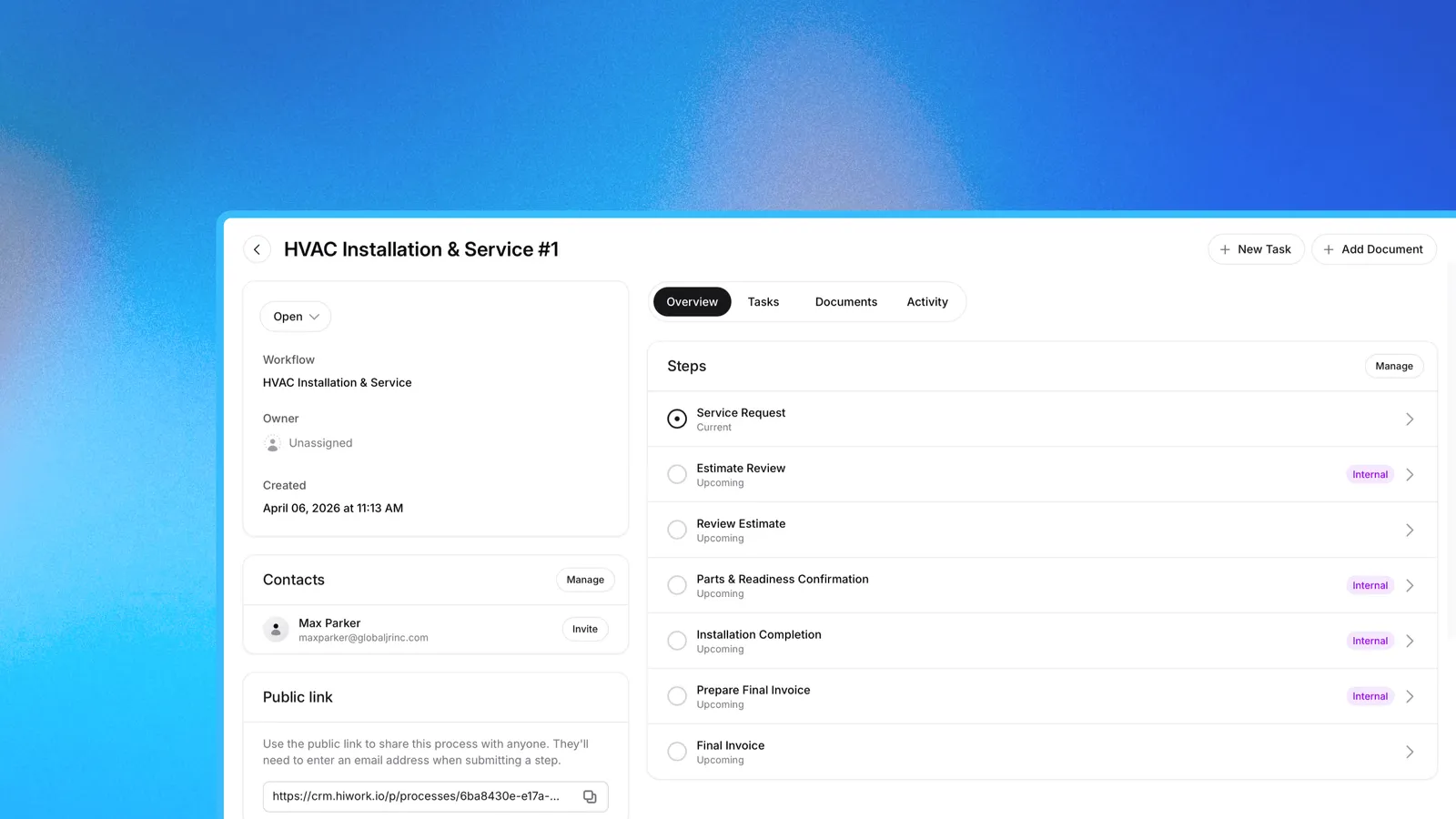
Workflow templates. You design the process once: the steps, what information gets collected at each one, and how work moves forward (automatically, on approval, or on rejection). That template becomes reusable for every new client.
Process instances. Each client, case, or engagement gets their own instance of the workflow. You can see all active processes at once, or drill into any one to see exactly where it stands.
Approvals and rejections. At defined steps, a team member reviews a submission and approves it (moving things forward) or rejects it (sending it back). Approvals are not buried in email threads. They are logged events with timestamps.
Audit trail. Every action is recorded. Who submitted what, when it was approved, what was attached. This matters for compliance, for handoffs, and for the inevitable “wait, what happened with this client?” conversation.
Custom fields. Each step can collect specific information. An intake form collects contact details. A review step might require a signed document. Information is captured where it belongs in the process, not scattered across inboxes.
5 reasons businesses need approval workflow software
1. Spreadsheets do not track approvals
Most teams start with a spreadsheet. It works for a while. You can see who is in what stage, update statuses manually, color-code by priority. The problem shows up the moment your process has any real complexity.
Spreadsheets cannot tell you who approved something, or when. They cannot enforce that a step actually happened before the next one starts. They have no memory of the back-and-forth, no attached documents, no notes from the review. When something goes wrong, or a client asks what happened to their case, you are digging through email hoping someone wrote it down.
Client approval software makes the approval an actual logged event, not a color change in a cell.
2. Email kills visibility
“Can you approve this?” threads are the graveyard of client operations. Someone sends a request, it gets buried, a week goes by, nobody followed up. Or someone approved something in an email that three other people never saw. Or the person responsible was on vacation and nobody knew.
When approvals live in email, visibility depends entirely on everyone’s inbox discipline. That is not a system.
Approval workflow software puts every pending decision in one place, assigned to a specific person, with a timestamp. If something is sitting idle, you can see it immediately.
3. “Who is responsible for this?” gets a real answer
This question kills more time than most people realize. A client moves through intake, goes quiet for a week, someone follows up, only to find that three people assumed someone else was handling it.
Workflow software assigns each step to a person. When that step is active, one person owns it. The handoff is explicit, not assumed. Everyone knows what is theirs, right now.
4. Your process becomes reusable
When your client process lives in someone’s head, or in a document nobody reads, or in an ad hoc set of email templates, it does not scale. Every new team member reinvents it slightly differently. Every new client is a minor experiment.
Approval workflow software means your process is documented by default. The steps are defined, the checkpoints are built in, and the information you need at each stage is specified. Onboarding a new team member means showing them the tool, not hoping they absorb months of institutional knowledge.
5. You get a record of everything
Compliance questions, client disputes, internal handoffs are all easier when every action in a process has a timestamp and an owner.
“What did we collect at intake?” is answered by the workflow record. “Who approved this?” is logged. “When did we send that?” is logged. The audit trail is automatic, not something you have to build separately.
This is one of the biggest practical differences between structured client workflow software and running the same work through email and spreadsheets.
Who this is actually for
Approval workflow software used to mean expensive enterprise tools, the kind that cost thousands per month and required IT to configure. That is changing.
Small to mid-sized teams that manage clients through any kind of structured process, whether that is intake, onboarding, review cycles, or approvals, now have options built for their size. Not the enterprise version. Tools you can set up yourself in a day.
Lattney combines contact management with structured, approval-based workflows in one platform. Your client records and your client process live in the same place. You design the workflow once, run it for each client, and the tool handles step assignments, approvals, document collection, and the audit trail.
If you are still managing your client process through a spreadsheet and an email thread, it is worth seeing what structured client workflow software actually looks like.
Frequently asked questions
What is approval workflow software? Approval workflow software is a tool where work moves forward only after a designated person reviews and approves a submission at each step. Instead of chasing approvals through email, every pending decision is visible, assigned, and timestamped in one place.
How is approval workflow software different from project management software? Project management tools track tasks and timelines for internal teams. Approval workflow software is built around structured processes with submissions, approvals, and routing, where each step requires a specific action before the next one begins. They solve different problems.
What is client workflow software? Client workflow software is a tool that moves clients or cases through a structured, step-by-step process with defined ownership and approval checkpoints at each stage. It replaces spreadsheets and email chains as the system of record for how client work gets done.
Do businesses really need approval workflow software? If you manage clients through more than one or two steps, such as intake, review, approval, and delivery, and you are tracking that in a spreadsheet or email thread, yes. The cost of missed steps, errors, and unclear ownership adds up fast. Approval workflow software makes those processes reliable without adding overhead.
What kinds of teams use client workflow software? Any team that moves clients or cases through a repeatable, multi-step process with reviews and sign-offs along the way. If your current process involves a spreadsheet and an email thread, you are a good candidate.
Is approval workflow software the same as a CRM? Not exactly. A CRM manages contact and relationship data. Approval workflow software manages the process each client moves through. Some tools, like Lattney, combine both, so your client records and your client workflows live in one place.