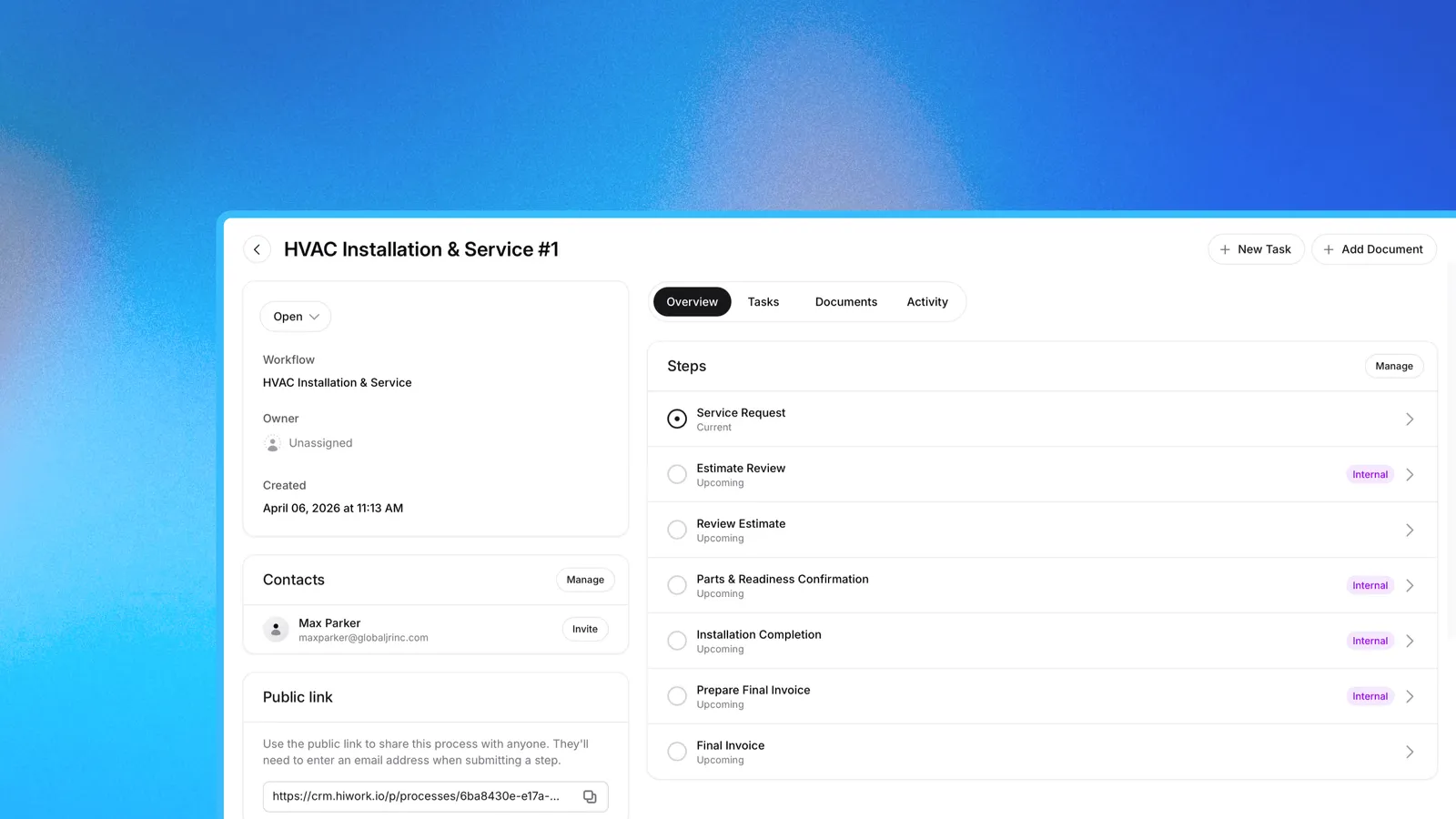
When onboarding a new client runs late, it is rarely your side that is late. The agreement went out on Monday and is still unsigned. You asked for the login to their accounting software and got a reply asking which one. The email with the two attachments you asked for is somewhere in their inbox, under everything that has arrived since.
None of that is the client stalling. They are running a business too, and they have no view of any of it. They cannot see the list of what you need. They do not know which items they have already sent, or how much is left before you can start. So they wait for you to ask again, and you wait for them to answer.
Every one of those days pushes back the day the work starts. That makes the client’s part of onboarding the part worth designing with care: the few moments when you need them to sign, send, or answer.
Three moments, not six
Search for a client onboarding process and you get a list of stages. One version runs welcome and kickoff, information intake, document collection, review and approval, signatures and payment, handover to delivery. Another counts five: work out what they need, define the outcomes together, brief your team, run a kickoff call, check in at 30 days.
Read either list with the client in mind and most of it turns out not to involve the client. A welcome email is something you send. Review and approval is you reading what came in. Briefing your team happens without the client in the room, and handover to delivery is a move between your own people.
What is left is three moments. The client tells you who they are and what they want. The client agrees to your terms. The client turns up to the kickoff. Call each of those a step: one thing that has to happen before the work moves on. Document collection looks like a fourth, but for most businesses it is part of the first ask, a few files sent along with the answers. It deserves a step of its own only when a client has enough documents that collecting them is separate work. Payment belongs with whoever sends the invoice, and plenty of businesses bill after the work starts, so it is not in the shortest version either.
The test for keeping a step is whether you would still run it on your worst week, with two people out and a deadline on Friday. Three steps pass that test. A step that some businesses would delete belongs in their own version, and the version worth writing down first is the shortest one that works.
A page the client can open
We make Lattney, a CRM with workflows built into it, and this is how an onboarding you build there behaves. A workflow is a set of steps, the fields each step collects, and the approvals it waits on; you build it once and run it for every new client. A workflow can have a share link, which you switch on and can switch off again. You put it in an email, a proposal, or your website, and anyone who opens it lands on a public page where they can start their own onboarding. Nobody needs an account, a password, or an invitation.
That page asks for one thing, an email address. Lattney finds the contact with that address or creates one, finds that contact’s unfinished onboarding or starts one, and emails them a link to it. The link arrives by email only. So the client has to be able to read mail at the address they typed, and that is what makes the address a check on who they are. The same address entered again brings back an unfinished onboarding rather than starting a second one, and once one is finished the same address starts fresh. A contact created this way stays out of your contacts list until they submit a step, so a typo or a stranger’s address never shows up there.
The link opens a page with your company name, the name of the workflow, and the steps, with the current one marked current and the rest upcoming. The client sees only the steps their onboarding can still reach, so a branch it did not take never appears. The client fills in the current step and submits it, and everyone on your account gets an email. When you approve a step and the next one the client can see opens, the client gets an email in turn.
Some clients will read that email and send you the answers in a reply instead. Somebody on your side can open the step and submit it for them. Lattney skips the email to your team in that case, since you already know, and the record stays complete even when the client never opens the page.
The step the client never sees
Between the client telling you what they want and the client agreeing to terms, one thing has to happen on your side. Somebody reads what came in and decides it is complete and worth taking on. No terms get written until that is settled. In Lattney that decision is a step, marked internal.
An internal step is filled in by your team, not the client. It is either hidden from the client entirely, or shown to them under a public name you choose. The internal name is never shown, and a visible step with no public name reads “In progress”. A hiring workflow uses this for “We’re reviewing your application”. The internal step holds the answers the client must not read: the scope you are agreeing to, the price, who on your team owns the account.
A connection between two steps carries one of three conditions: the next step opens when the previous one is submitted, when it is approved, or when it is rejected. A step whose connections are all immediate is approved on submit, with no review. Connections only point forward. Lattney refuses a connection that would form a loop, so a workflow cannot route backwards. Going back is a retry instead. A step marked retryable reopens when it is rejected, so the same person corrects it and submits again. Mark the steps a client can get wrong. Retry only applies when the step has no rejection route of its own; a specific route wins and the step stays closed.
The agreement step waits for an approval of its own, separate from the one on Review.
| Step | Who fills it in | Moves on when |
|---|---|---|
| Your details | The client | They submit it |
| Review | Your team | Somebody approves it |
| Your agreement | The client | Somebody approves what they sent |
| Kickoff | The client | They submit it |
What goes inside a step
A step collects its answers through fields. There are thirteen kinds: single line text, long text, number, date, email, phone, web link, checkbox, file upload, a dropdown with one choice, a dropdown with several, and two that collect nothing. The first of those is a block of text you write, shown to whoever fills the step in. The second shows back an answer from an earlier step. Any field except those two can be marked required, and a submission missing a required answer is refused when they press submit.
Your details opens with a block of instructions saying what happens after they submit. Then their name, email and phone, a long text field for what they want done, and one file field for anything they already have. Review holds the scope, the price and the account owner as three fields. Your agreement is a block of text carrying the terms, a file field for the signed copy coming back, and a checkbox recording that they accept. Kickoff asks for a date, and shows back what they said they wanted at the first step, so nobody has to re-read the thread before the call.
A file field takes one file, up to 10 MB. PDF, Word, Excel, PowerPoint, PNG, JPEG, GIF, WebP, plain text, CSV, ZIP and RAR are accepted. Email, phone and link fields change the keyboard on a phone and the browser’s own hint. Nothing rejects a value that is not a real address or number, so anything that has to be correct still has to be read by a person.
There is no signature field. A signed agreement is a file the client uploads and somebody on your side approves.
Where the fifth step goes
Each addition slots between two steps that are already there. Add it the first time a client makes you do the work by hand.
- Collecting documents goes after Your details, once there is enough of it to chase.
- Recording payment goes after Your agreement, for a business that gets paid before the work starts. The money moves the way it already does, by invoice, card, or transfer. The step records that it arrived, so Kickoff cannot open until it has.
- Preparation on your side goes before Kickoff, marked internal, when your setup is real work: accounts to open, materials to order, a folder to build. What it holds is different in every business, which is why the short version leaves it out.
- A discovery call goes before Your agreement, when the scope needs a conversation before anyone writes terms.
A “not a fit” ending is a step you add too, with a rejection routed to it. When you add a step the client fills in, name it the way the client would read it, because the name is what they see on their page. Your internal steps can use whatever names you use in the office.
Notes, tasks and the onboardings running for a client all sit on that client’s contact record. Ready-made templates exist for hiring, home service jobs, real estate and professional services. None of them is the onboarding above, so that one you build.
The 30 day check-in on the checklists you find online is worth doing. It happens weeks later, and putting it inside onboarding would leave every client’s process sitting open until it came round. Put it in a calendar.
Onboarding ends at Kickoff. What happens from there belongs to whatever process you run for the work itself.
Writing this down does not make a client sign faster. A client who needs a week to read the agreement still takes the week. What it removes are the other days: the ones lost because the client did not know it was their turn, or because you did not know what they had already sent. Those days were never anyone’s decision.
Frequently asked questions
What is a client onboarding process? The sequence of things that happen between a client saying yes and the work starting. Most of it runs on your side. The client’s part is three things: saying who they are and what they want, agreeing to your terms, and showing up to the kickoff.
What are the steps in a client onboarding process? The shortest version that works has four: Your details, Review, Your agreement and Kickoff. Three of them are the client’s. Anything else your business needs, such as collecting documents, recording payment or a discovery call, goes in between two of those.
How long should client onboarding take? As long as the client takes to do their part. Your side is usually quick. The delay comes from the client signing, sending or answering. A written process shows both sides which step is open and who it is waiting on, and the client gets an email when you approve a step and the next one they can see opens.
What should a client onboarding form ask for? Their name, email and phone, a description of what they want done, and one file field for anything they already have. A file field holds one file at up to 10 MB, so a client with two documents needs two fields. Put the instructions inside the form and say what happens after they submit. Leave scope, price and account ownership out. Those are your answers, and they belong in an internal step.
Can you run client onboarding in a spreadsheet? A spreadsheet holds the list of steps and who is on which one. It cannot collect a file from a client, hold the work until somebody on your side approves it, or show the client where they are. Those three are where onboarding stalls, so the spreadsheet keeps the record and you still chase the client by email.