You had a handful of clients and a process you could hold in your head. Names down the left, stages across the top, a column for the date you last chased someone. It cost nothing, it took twenty minutes to build, and everyone already knew how to use it.
Then at some point it stops working, and the awkward part is how quietly that happens. Nothing breaks. No file gets corrupted. The sheet still opens, still sorts, still looks organized. Meanwhile the real story of what is happening with your clients has moved into everyone’s inbox, and the sheet has become a summary that somebody has to keep typing up.
Most teams pass that point months before they notice it. Here is what to look for.
The four signs your spreadsheet has stopped working
- The sheet and the inbox disagree
- Someone has to ask whose turn it is
- Answering “what happened here?” takes real digging
- Keeping the sheet updated has become a job
Here is what each one looks like in practice.
1. The sheet and the inbox disagree
The status column says “waiting on documents.” The client actually sent the documents on Tuesday, and the only evidence of that is an email in one person’s inbox. Whoever opens the sheet next is reading something that was true last week.
Once two places both claim to describe the same job, you do not have a tracker any more. You have a tracker and a rumor about the tracker. People quickly learn which one to trust, and it is rarely the sheet.
2. Someone has to ask whose turn it is
A row can tell you what stage something is in. It cannot tell you who is holding it right now.
So the question gets asked out loud instead. In a meeting, or in a message to the whole team, or not at all, while two people each assume the other one is on it. The job does not stall because somebody dropped it. It stalls because ownership lived in people’s heads rather than in the process.
3. Answering “what happened here?” takes real digging
A client calls and asks why their project is where it is. Or a colleague picks up a job halfway through while the person who started it is away. Either way, someone now has to reconstruct the history: scroll the email thread, check the shared drive, ask around.
A spreadsheet keeps the current state and overwrites everything before it. Change a cell from “in review” to “approved” and the fact that it sat in review for three weeks disappears, along with who approved it and what they were looking at when they did. That history is usually the exact thing you need.
4. Keeping the sheet updated has become a job
Watch how much time goes into maintenance. Someone chases people for status updates so they can type those updates into cells. Someone fixes the formatting after a paste. There is a weekly pass to catch the rows that went stale.
None of that work produces anything for the client. It exists because the record and the work are two separate things, and a person has to keep walking between them.
Why a bigger spreadsheet does not fix it
The usual next move is to make the sheet better:
- Add an owner column
- Add conditional formatting, so anything untouched for a week turns red
- Lock the cells people keep breaking
- Write a macro
Those help a little, and they run into the same wall.
None of this is really an argument against spreadsheets. A spreadsheet is very good at holding a list and letting you look at it from different angles. Sorting, filtering, totaling a column, comparing this month against last. If you want to know how many jobs you closed in July, or which clients have not been contacted since spring, a sheet answers that in seconds.
What it does not do is carry work. A cell holds a value. It does not hold a person who is responsible for that value being right, or a rule about what has to happen before it can change, or a record of who changed it last week and why. A spreadsheet records what you tell it. It cannot require that a step actually happened before the next one starts. It cannot ask one named person for a decision and then wait for them. It cannot keep a copy of what was true yesterday.
Those are the things you started needing when the process got real, and no amount of columns adds them.
What to do instead
Before looking at any tool, write your process down as steps. For each step, answer three questions:
- What has to happen here?
- Who is responsible for it?
- What has to be true before it can move on?
Most teams find this part uncomfortable, because it surfaces the decisions nobody ever actually made. That is the useful bit.
Then move the process somewhere that can hold it, and let the spreadsheet keep the jobs it was always good at. Reporting. Ad hoc analysis. The one-off question nobody planned for.
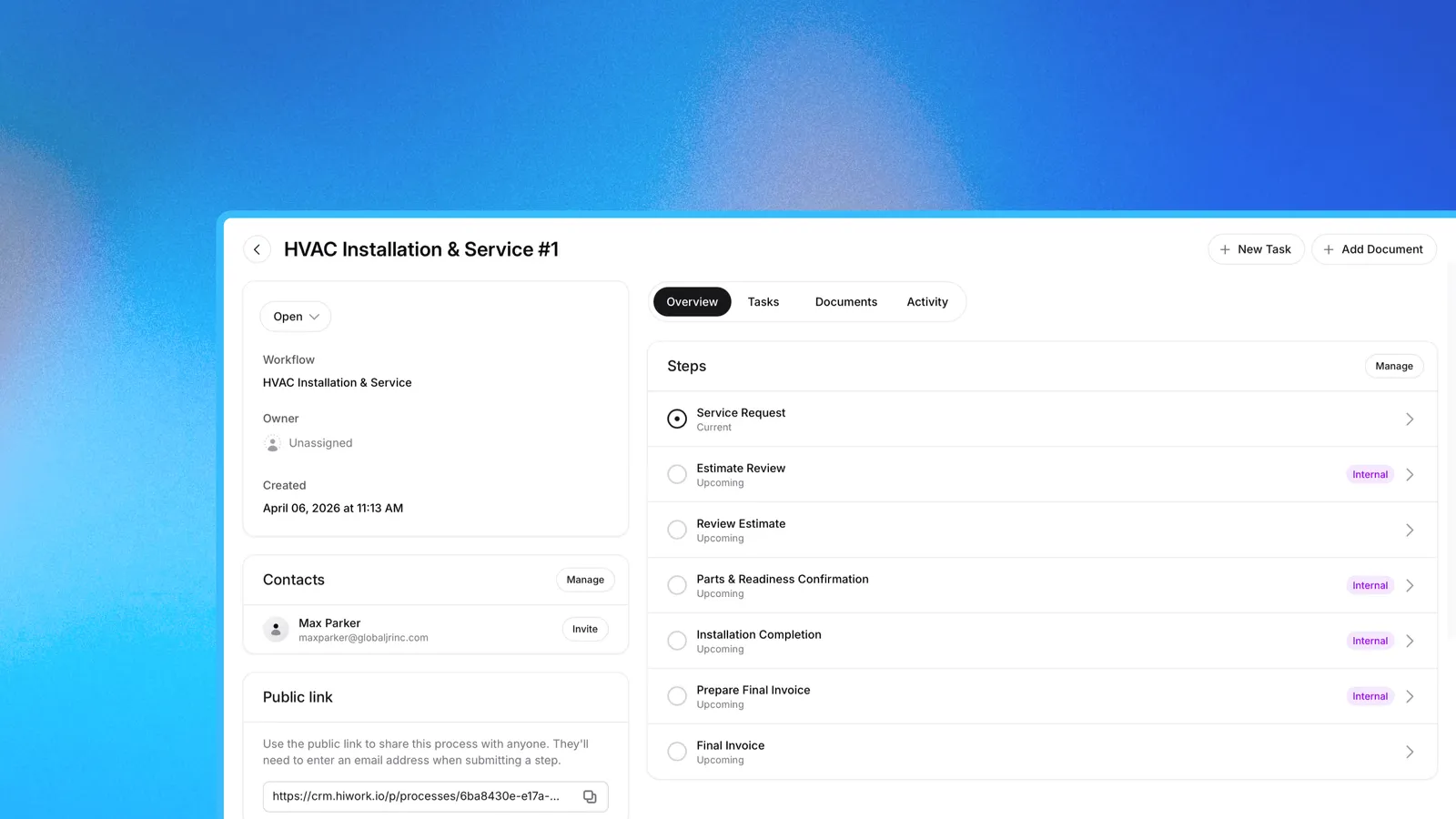
Lattney is a tool that helps you turn that process into something your team can run the same way every time. You build a workflow once, with its steps, owners and approval points, then use it for every new client or job. Each step is assigned to a person. Nothing moves on until the right person signs off, and every submission and approval is recorded with a time and a name against it. Your contacts live in the same place, so the client record and the process that client is going through stop being two separate systems.
If you would rather start from something than from a blank page, there are ready-made templates to build on.